 THE ESSENTIAL GUIDE FOR
HOMESTAY
STUDENTS IN NORTH AMERICA
THE ESSENTIAL GUIDE FOR
Overseas students living with North American families in homestays face many challenges - culture shock, unfamiliar foods and language barriers, just to name a few.
The Essential Guide for Homestay Students in North America offers students help in facing these challenges so that homestay will be an experience they can treasure for the rest of their lives. The 60-page booklet is easy to read and full of useful tips and ideas. It covers everything from adjusting to life with a new family to how to manage money and banks.
The booklet is available in Arabic, Chinese, English, Japanese, Korean, Portuguese and Spanish editions.
Since it was published in 1998, thousands of copies have been distibuted by homestay coordinators to their homestay students and host families. Here's what organizations are saying about the booklet:
"We are very pleased with the organization of the booklet. It explains what the students really want to know in a way they can easily understand. The students and their host families have nothing but positive comments." - Jan Titus, California State University at Bakersfield.
"This is a GREAT orientation tool." - Judy Bellis, Belmont Secondary School, British Columbia.
"Phenomenal! This book says everything! It helps students to establish realistic expectations." Hillary Bennett, Monterey Institute of International Studies, California.
For more information about the Essential Guide for Homestay Students in North America, call ICI Communications at 613-542-9876 or contact us.

The guidebook covers everything from culture shock, to the role of women to operating home applicances to personal safety. Following are two excerpts from the booklet:
Expectations
It helps to have clear expectations before leaving and to evaluate whether they are realistic. You may even want to write them down to be open with yourself and to have a record for later.
What does homestay mean for you? What do you expect and want from the experience - and from the people who will play a large role in it? How much nurturing do you need?
It's essential to consider what you can do for your host and not simply remain preoccupied with what the host can do for you.
When you are in North America, as you encounter problems you can return to your expectations and consider their part in any disappointments. Maybe your expectations were unreasonable. Maybe you have not tried hard enough to achieve your goals.
Some misconceptions that are common:
North America is glamorous and everyone is rich - just like in Hollywood movies. In fact, you will probably be living an ordinary life with a family that is neither rich nor poor. It probably, for example, won't have a maid to look after your needs.
North America families are all white and headed by a mother and father. In fact, North America is quite multicultural and as we've said the nature of families is quite varied.
The family will dote on you, with the mother devoting much of her day to making your life easier. In fact, family memebers will cherish their time with you but they have their own lives to lead.
The homestay will be like a hotel. In fact, you will have your own room but likely be sharing all the other facilities.
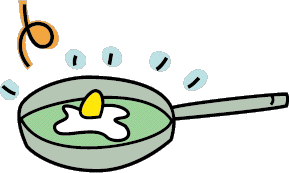 Meals will be like a restaurant. You will have a large breakfast
with a convenient choice; several options for lunch; and a full-course dinner,
with soup and dessert. In fact, meals tend to be hurried and often quite
casual.
Meals will be like a restaurant. You will have a large breakfast
with a convenient choice; several options for lunch; and a full-course dinner,
with soup and dessert. In fact, meals tend to be hurried and often quite
casual.
You will be the only homestay student in the household. In fact, often more than one student will be living with the family. That may be an advantage, as it gives you somebody with whom to share your experience.
The homestay is a convenient spot to wait while you search for another place to stay. In fact, that is highly unfair to the homestay family who could have taken another student for the full term. It also cheats yourself, because homestay is an important part of the experience of learning a new language and culture.
Some students think that after homestay they will be able to speak English like a native. English is a very complex language and speaking it well takes considerable time. But rest assured, you will improve your English dramatically.
By keeping your expectations reasonable - and clear - you will better enjoy the homestay experience.
Meals
Most homestay hosts provide breakfast and dinner. Usually, you can make a lunch to take to school. The food will be very different from what you are accustomed to and the manner of eating will probably be as well.

Dinner will be more like what you are accustomed to, in the sense that everybody tries to eat together and a parent usually cooks. But it's probably at a much earlier hour and sometimes rushed, because family members may have events to attend in the evening. Again, we stress it's your responsibility to be home for dinner on time. Don't expect the mother to be patiently waiting, with the food still warm, if you arrive two hours later. Instead, you will have to reheat any leftovers or make a sandwich.
"The booklet has really opened the lines of
communication between host families and students."
Ann Blatt, Edmonds Community College
Lynnwood, WA
"We are very pleased with the organization of the booklet.
It explains what the really need to know in a way they can
easily understand. The students and their host families
have nothing but positive comments."
Jan Titus, California State University
Bakersfield, CA
"This book is a great resource with a wide
range of uses for our homestay program."
Helen Jackman, Spring International Language Center
Littleton, CO
"This is a GREAT orientation tool."
Judy Bellis, Belmont Secondary School
Victoria, British Columbia
"It is very important to have this guide for students
to turn to during their adjustment period. This book is a wonderful resource!"
Maureen Sargent, Saint Mary's University
Halifax, Nova Scotia